Suva exhibition brings greater visibility to women artists in Fiji.
Story curated by EXPLORE Fiji®
Fiji has never been short of talented women artists. What has often been missing is the visibility their work deserves.
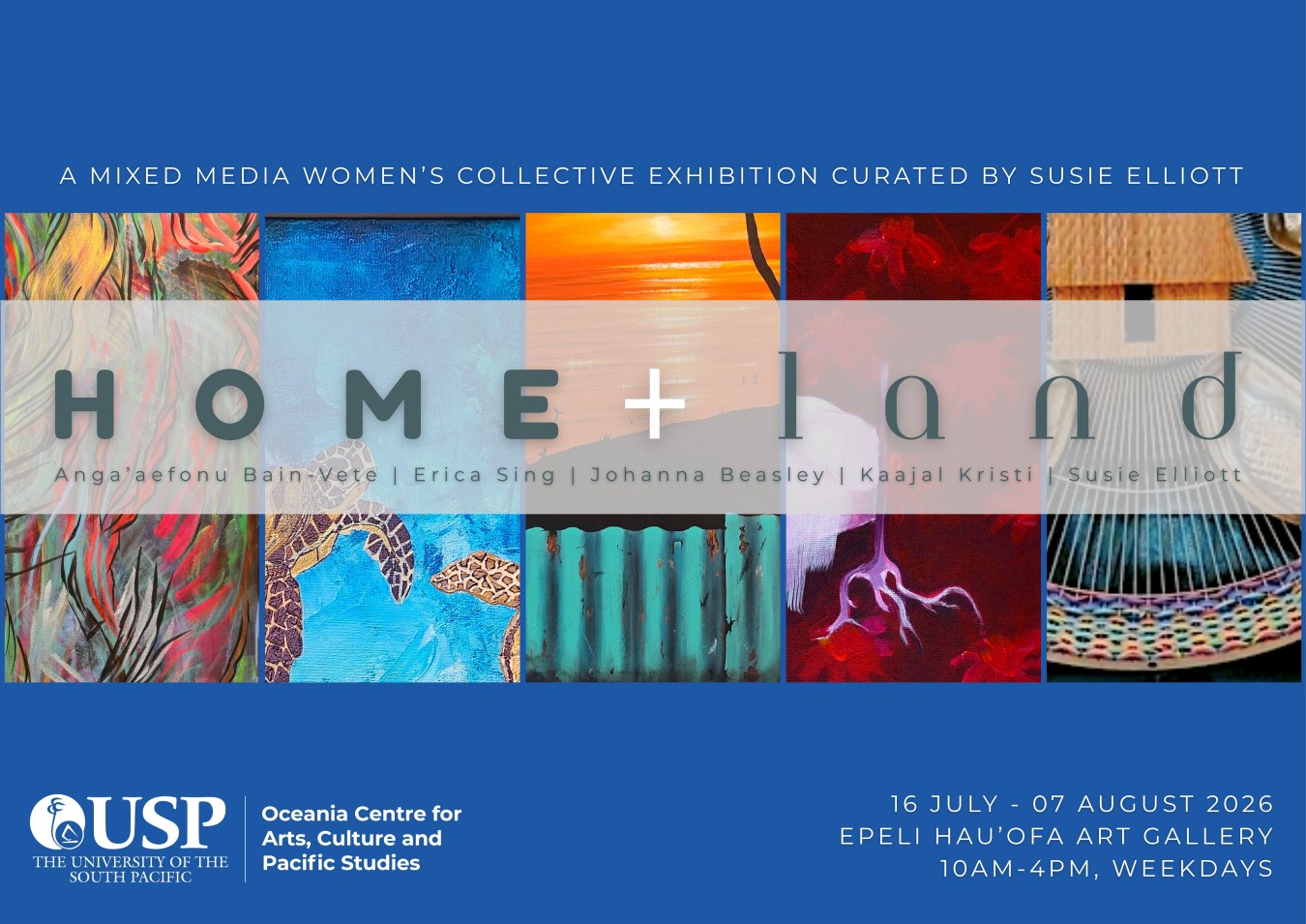
That is one of the conversations unfolding through HOME+LAND, a new mixed media exhibition now open at the Epeli Hau’ofa Art Gallery at the Oceania Centre for Arts, Culture and Pacific Studies, The University of the South Pacific in Suva.
Curated by seasoned artist Susie Elliott, who is based in Nadi and works from InkBone Arts Studio, the exhibition brings together a talented collective of female artists Anga’aefonu Bain-Vete, Erica Sing, Johanna Beasley, Kaajal Kristi and Elliott herself. The thoughtfully curated collection of paintings, drawings and assemblage works explores home, land, identity and belonging through the lived experiences of the five women.
Running until August 7th 2026, the exhibition offers more than an opportunity to admire contemporary art. It invites visitors to pause and reflect on the places, people and memories that shape who we are. At its heart is Elliott’s desire to create greater visibility for women’s stories within Fiji’s visual arts community.
“The idea to have an all-female exhibition arose out of a recognition that women’s stories via the visual arts platform was underrepresented or lacking and I wanted to have an all women exhibition as a way of redressing that imbalance,” she explains.
“The female artists in this exhibition were chosen because they were women who were active in various stages of their art practices and when approached with the idea, were very enthusiastic about participating.”
It is a theme that resonates well beyond the gallery walls.
Finding Home in More Than One Place
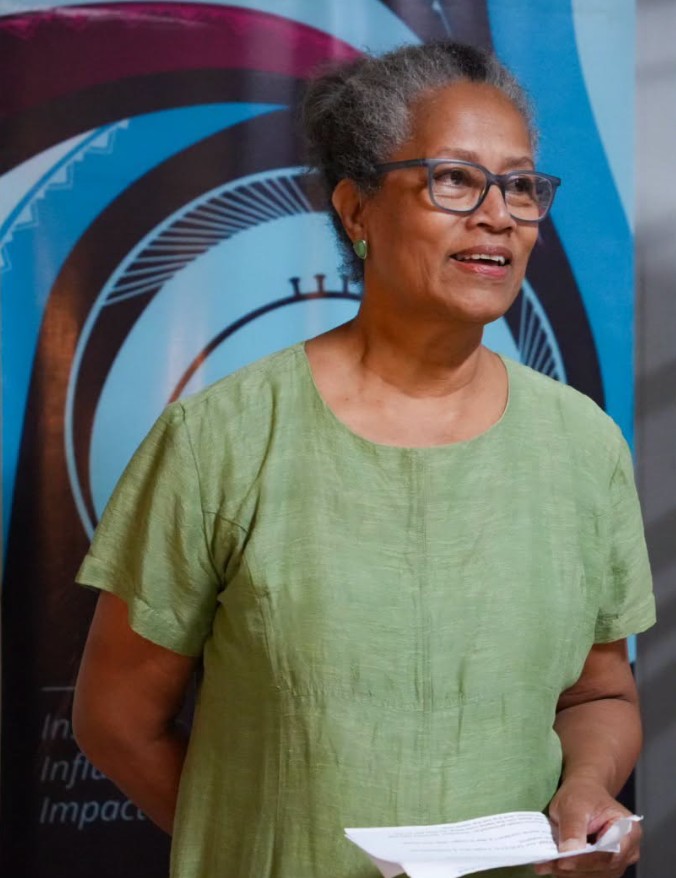
For Elliott, HOME+LAND grew from questions she had been asking herself for many years. Born of Scottish and iTaukei heritage, she has paternal links to Nabuna on Koro Island in Lomaiviti and Naceva in Kadavu, while her maternal family comes from Toga in Rewa and Verata in Tailevu. Raised and educated in Suva, she attended St Anne’s Primary School before continuing to St Joseph’s Secondary School.
Looking back, Elliott says her artistic foundations were laid long before she ever stepped into an art school.
“I think my early influences towards the Arts were shaped both by my iTaukei and part-European background in the home, which was underpinned by my Catholic upbringing,” she said.
“Unconsciously done, these are reflected in my choice of colours in my paintings which are the colours from this place, and a ‘staging’ of elements that hints at storytelling.”
Those early influences continued to evolve as life took her overseas. While living in the Philippines as the wife of a diplomat, Elliott learned Chinese brush techniques, an experience that deepened her interest in the arts and expanded the way she approached creativity.
Later, in Aotearoa New Zealand, she completed a Bachelor of Fine Arts in Printmaking at the Universal College of Learning before undertaking postgraduate studies in Museum Studies at Massey University.
Travel, formal arts education, galleries and museums all helped shape her artistic practice, but so too did everyday experiences of life abroad.
“I’ve come to the conclusion that artists are both born and made,” she reflects.
“For me what came first was a home and school environment that encouraged reading and writing. Both tilled the ground for curiosity and imagination to thrive. Handwriting naturally progressed to drawings which later developed into artworks.”
Her years overseas also gave her something less tangible: perspective.
After more than three decades living abroad, Elliott returned to Fiji in 2017. Coming home prompted fresh reflections on memory, identity and belonging, themes that now sit at the heart of her work.
What does home really mean?
“Home, for me is a curious term in my stage of life,” she says.
“There are many definitions of home.”
“When living abroad, there is never any doubt in my mind that Fiji is home. But curiously the Fiji I’ve returned to is a familiar and strange country.”
The experience also brought what she describes as “a feeling of fragmentation in the sense of where I belong,” a tension reflected in the works she presents in HOME+LAND.
She speaks candidly about returning to a place that had changed in both visible and deeply personal ways.
“Many physical landmarks of my youth have been erased, built-over, or are now derelict.”
Even more profound was the absence of the people who had once defined home.
“Both my parents and many members of my extended families have passed on, which I realised that they are the reasons why Fiji is ‘home’.”
Today, with family also established in Aotearoa New Zealand, Elliott’s understanding of belonging has shifted.
“The people I love is where a version of home for me is.”
That evolving sense of belonging threads its way throughout HOME+LAND, where ideas of memory, place and identity are explored not as fixed ideas, but as experiences that continue to change over time.
Memories That Become Art
Returning to Fiji also changed the way Elliott looked at its landscapes.
In 2020, a Creative New Zealand Arts Grant enabled her to spend time drawing in Koroyanitu National Park, the Sabeto area and the Sigatoka Sand Dunes.
Those solitary hours outdoors became deeply significant. Reflecting on that experience, Elliott says:
“Time spent alone out in these landscapes gave me a deep respect and a love for these ancient locations and how often they remind me of how insignificant I am in context.”
Although trained as a printmaker and self-taught in oil painting, Elliott’s works for HOME+LAND reflect her continued exploration across different forms and materials.
Sometimes, the drawings appeared unexpectedly.
“I have a respect for drawings done by hand in the ‘old-fashioned’ sense. Sometimes, during painting, ideas for a drawing would arrive unbidden and I would run with it.”
Even familiar sounds have found their way into her work. Elliott recalls:
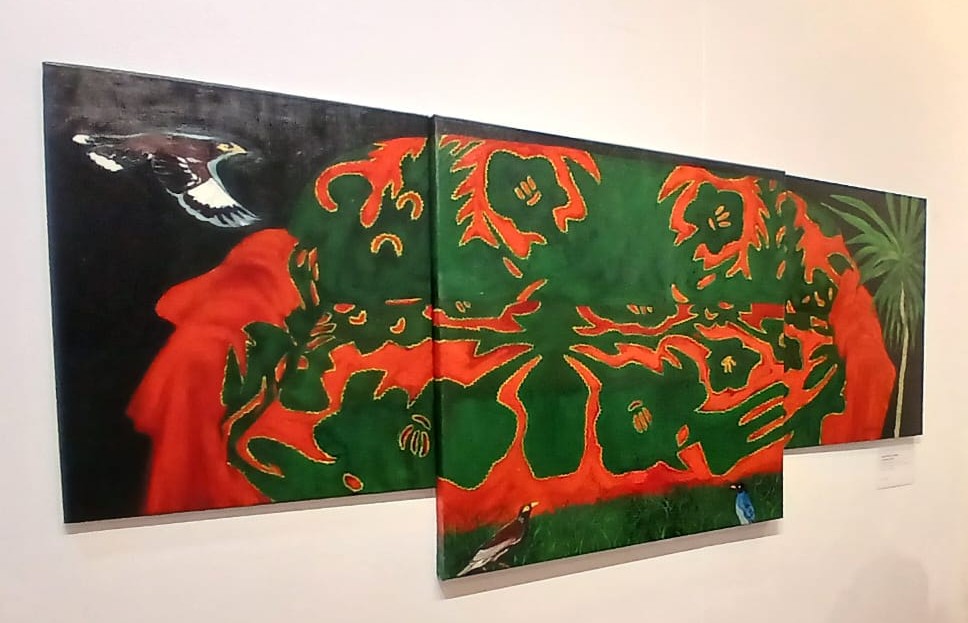
“Curiously, one of the sounds I often missed living abroad was the quarrelsome Mynah birds here in Fiji. And now they’ve crept into my work and I’ve let them be.”
Her Lacadrau triptych carries equally personal meaning.
For HOME+LAND, Elliott is presenting a triptych painting and three drawings, with the triptych created in acrylic and the drawings developed using graphite, watercolour and ink on large sheets of paper. The triptych carries the name Lacadrau, the iTaukei term for a traditional patchwork quilt, stitched from hundreds of scraps of fabric into a single, warm bedspread, historically an emblem of community and unity.
Elliott’s painting is based on an unfinished king-sized bedspread she made herself while living in Niue, where this form of quilt is known as a tivaevae. The piece remains part of her Nadi studio today, draped over a couch.
Like many of the works in the exhibition, Lacadrau draws together memory, craftsmanship and belonging, showing how objects created by hand can hold stories that travel across time and place.
Elliott hopes the work encourages visitors to consider their own relationship with the idea of home.
“I hope that it in turn questions their own definitions and ideas for what the terms means for them.”
Before entering the gallery, Elliott hopes visitors make one small adjustment.
“To bring their full attention to bear when engaging with the artworks. To turn their phones off and really listen to what the overall shape and form and the materiality of the work is saying in the context of HOME+LAND.”
The exhibition brings together five different artistic perspectives, each shaped by personal histories, experiences and relationships with place.
Anga’aefonu Bain-Vete
Internationally recognised multidisciplinary artist Anga’aefonu Bain-Vete approaches the exhibition from both an artistic and cultural perspective, drawing upon ideas deeply embedded across the Pacific.
A graduate of the San Francisco Art Institute with a Master of Visual Culture from Monash University, Bain-Vete has exhibited and performed throughout Fiji, Australia, Europe and the United States. Yet despite that international experience, her contribution begins with something profoundly universal.
Bain-Vete says:
“The first home is the body, nourished in utero by the body of the mother and by the land, from conception throughout life.”
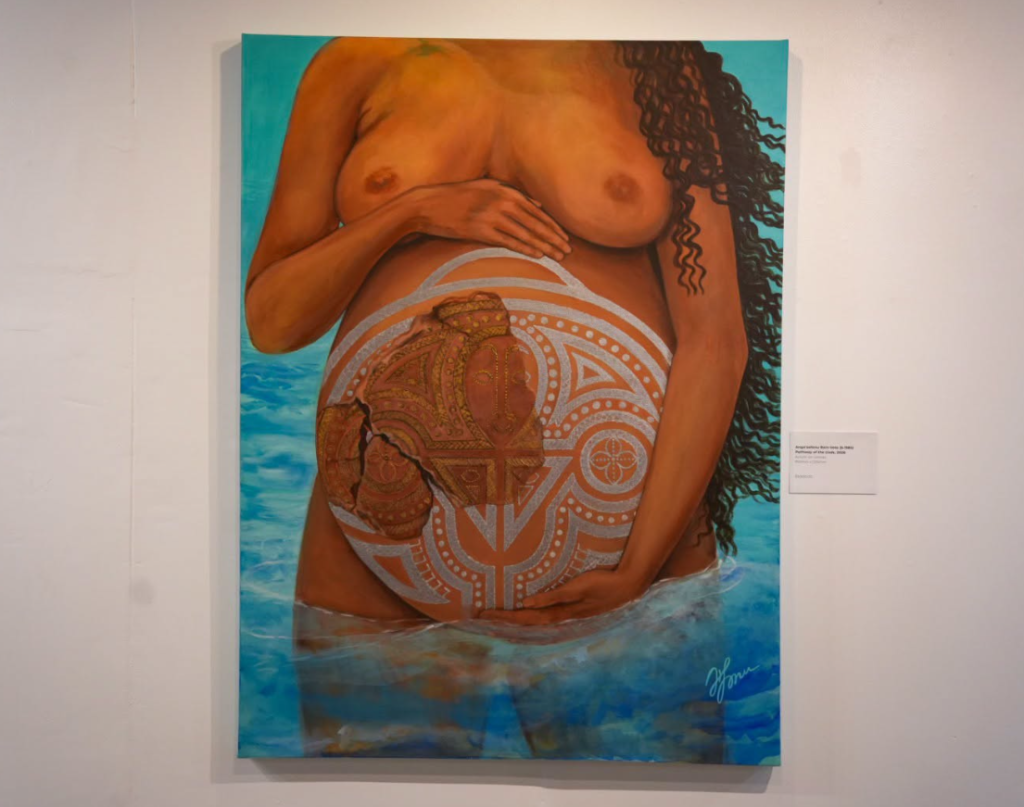
She draws connections across Oceania through related words including vanua in Fiji, fonua in Tonga, pū fenua in Tahiti, fanua in Samoa and whenua in Aotearoa New Zealand, each expressing the enduring relationship between people, place and identity.
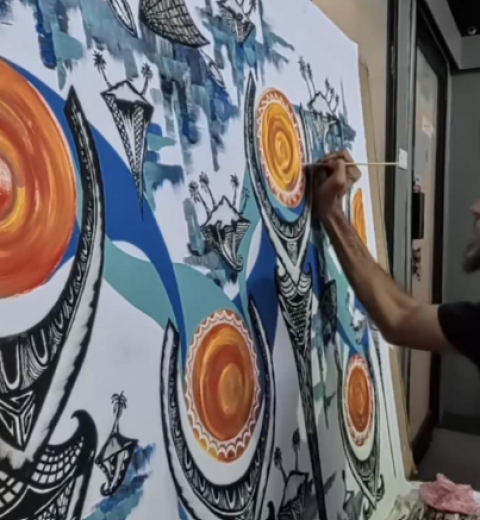
Her Umbilical Chords series explores painting itself as an act of creation. Created live during Adelaide Fringe Festival 2026, the large-scale works respond instinctively to rhythm, music and movement.
Bain-Vete explains:
“For me this is a practice of being nourished by a source, tapping into a flow, and trusting in pathways the body understands more than the mind does.”
Rather than depicting home as a destination, Bain-Vete presents it as something intrinsic, an enduring connection between body, land and ancestry.
Erica Sing
Lautoka-based painter Erica Sing finds meaning in everyday objects that capture the spirit of Fiji. Her journey into fine art is itself a story of reinvention.
After working as a flight attendant with Fiji Airways, Sing chose to pursue painting full-time, building a reputation over the past seven years for highly detailed realist works inspired by the familiar textures of island life.
Sing says:
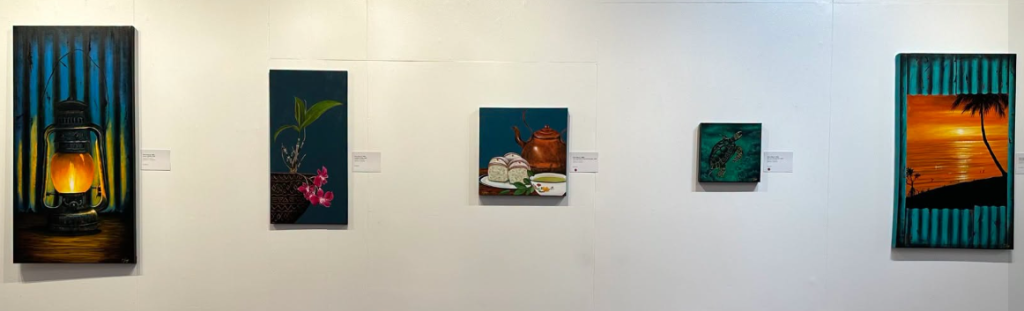
“My work often represents my home, Fiji. A planned painting would meander its way off course and become a piece of home before I even realise it.”
Old timber weathered by the tropics, peeling paint, kerosene lanterns and well-used household items become reminders of childhood, family and a slower pace of life.
She says:
“I feel a strong connection to the past and many of my pieces reflect this. A simpler time.”
Working primarily in acrylics, Sing hopes her paintings encourage people to pause long enough for forgotten memories to return.
Sing says:
“I want to offer a quiet moment to the viewer where a forgotten memory tucked away is brought back to life on canvas. Most of all, I want the viewer to feel comforted knowing that we are all at home together.”
Her paintings celebrate the beauty found in ordinary moments, reminding viewers that some of our strongest connections to home are often hidden within the everyday.
Johanna Beasley
Originally from Australia, Johanna Beasley’s connection with Fiji has evolved over decades, shaping both her artistic practice and her understanding of home and belonging. Based between Fiji and Australia, she holds dual Fijian and Australian citizenship, with Kadavu continuing to hold a special place in her life.
Well known within Fiji’s visual arts community through both her creative practice and her long career as an educator, Beasley has served as Visual Arts Coordinator at the Oceania Centre and contributed extensively to educational and community arts programmes in Fiji and Australia over more than four decades.
Since her retirement, she has been making topical sculptural works from her hunting and gathering in her extended Nadi studio.
Beasley’s works combine recycled materials with drawing, giving discarded objects a renewed purpose while preserving the memories they carry.
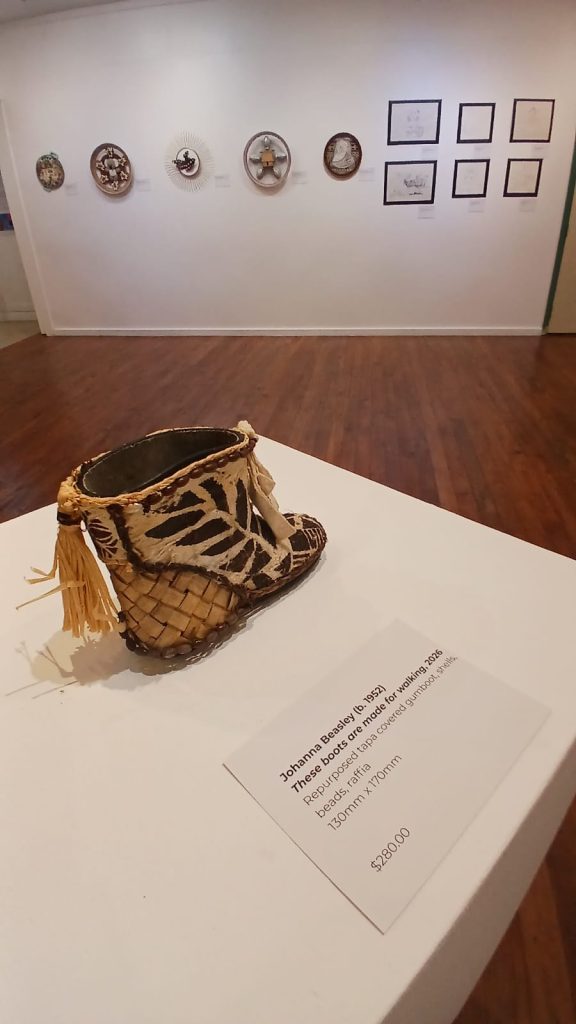
Beasley says:
“I have always been a hunter-gatherer of past memories and find comfort in the familiar.”
Her concern for the environment sits naturally alongside this practice, with reclaimed objects becoming reminders of the many places she has called home throughout her travels. Alongside these assemblages, her linear drawings revisit recurring motifs including shoes, fish, landscapes and the human body.
She explains:
“The motifs represent the illusory nature of home and the constant search for belonging.”
Together, her works offer another perspective on the exhibition’s central theme, suggesting that home is something continually rediscovered rather than permanently found.
Kaajal Kristi
Representing a younger generation of artists is Kaajal Kristi, whose passion for painting began while she was still a Year 11 student.
Over the past seven years she has steadily developed her practice, exhibiting as part of Suva’s Blue Wave Collective while working across several artistic media. Acrylic painting remains her preferred medium, allowing her to translate vivid childhood memories into richly coloured works.
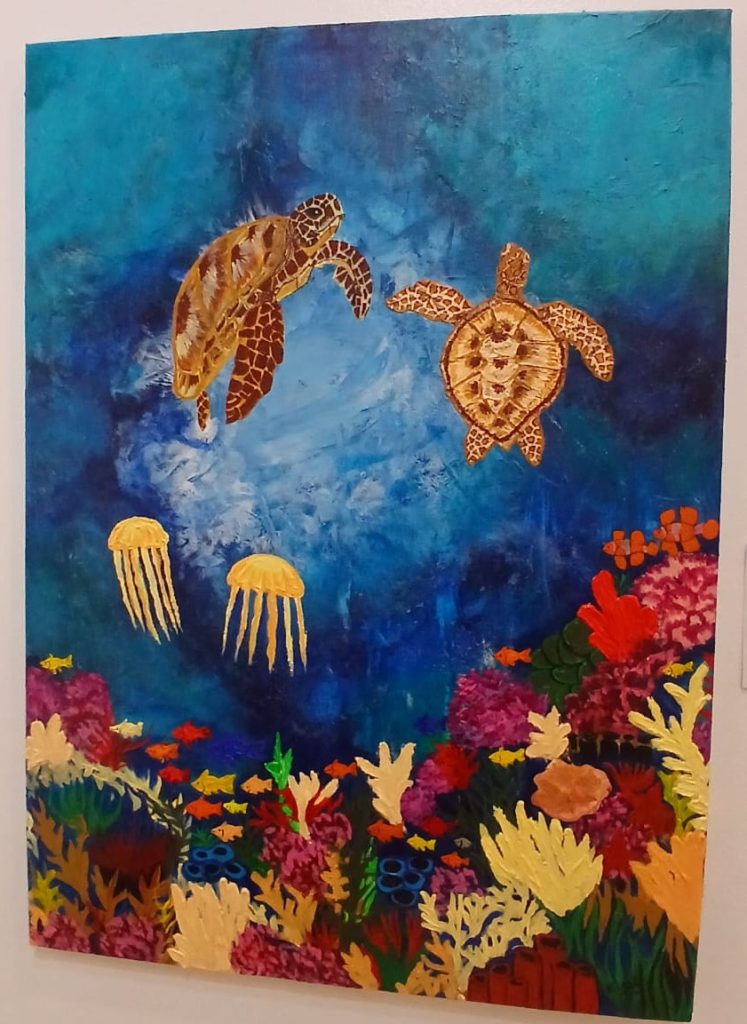
Kristi says:
“They say, ‘home is where the heart is’. My artworks explore the deeply intertwined relationship between home and land in Fiji, viewing home and vanua as an inseparable sense of belonging.”
Her paintings are populated with images of the ocean, parrots, forests and conch shells, each carrying personal meaning while reflecting a broader connection to Fiji’s natural environment.
She says:
“To me, home is more than a shelter; it is an emotional anchor and the living breath of the reef and soil.”
Kristi hopes viewers recognise something of their own experiences within her paintings, reminding them that the landscapes we inherit continue to shape our memories, identities and sense of belonging.
Her contribution offers a contemporary perspective while reinforcing the exhibition’s central message that every generation experiences, and defines, home in its own way.
A Conversation That Continues
Although each artist arrives at HOME+LAND through a different life experience, together their works offer deeply personal reflections on ancestry, migration, memory, motherhood, landscapes and community. Rather than presenting a single definition of home, the exhibition invites visitors to consider how belonging evolves through the people we love, the places that shape us and the memories we carry.
In bringing together five women with distinct artistic voices, HOME+LAND celebrates the richness of Fiji’s contemporary visual arts community while creating greater visibility for women’s stories. It is a reminder that home is not always a place. Sometimes, it is the connections and experiences that stay with us long after we leave.
*The Epeli Hau’ofa Art Gallery at the Oceania Centre opens Monday to Friday from 10am to 4pm. Free entry.
#EXPLOREFiji #FijiArts #FijiVisualArts #WomenArtists #PacificArts #ContemporaryArt #FijiCulture #Suva #EpeliHauofaArtGallery #OceaniaCentre #HomeAndLand